Hawai‘i ‘Ulu Cooperative
Created in 2016, the ‘ulu cooperative is a farmer-owned business working to revitalize ‘ulu as a viable crop and dietary staple by empowering farmers as change-makers in Hawaiʻi’s food system.

Māla Kalu‘ulu
A South Kona workers cooperative that specializes in traditional agroforestry methods and crops and serves as a research and educational site for teaching traditional Hawaiian agroecology.

Nui Kealoha
A family-run company that offers food and education grounded in the traditional values and cultural practices of Chef Kealoha Domingo’s Hawaiian ancestral roots.
ResiRoots Cafe
A Kaua‘i business that manufactures flour blends using kalo, cassava, green banana and ‘ulu, crafting products that highlight these island-grown ingredients.
Hawai‘i Island farmer Tom Menezes has been growing ‘ulu, or breadfruit, on and off since the 1980s, but didn’t have a consistent market to sell his harvest to until recently.
Despite being an important staple crop in Hawai‘i’s history, ‘ulu hasn’t been a widely eaten, mainstream food. Menezes would get calls from individual buyers here and there, but since ‘ulu quickly ripens within three to five days post-harvest, it was difficult to sell everything.
That changed after he joined the Hawai‘i ‘Ulu Cooperative in 2018. The organization buys ‘ulu from its nearly 200 member farms on four islands; processes it into steamed and frozen quarters, flour, hummus and other products; and handles all the sales and marketing. The co-op also processes kalo, ‘uala and pala‘ai (kabocha pumpkin).
“The co-op is actually a godsend to help farmers,” said Menezes who has farmed on O‘ahu, Maui and Hawai‘i Island for over 40 years. “It’s real stressful for a farmer to grow something and then have a hard time trying to sell it, so with the co-op there, it really takes all of that stress away.”
In the last year, the organization processed about 230,000 pounds of ‘ulu, plus 370,000 pounds of kalo, ‘uala and pala‘ai, said Dana Shapiro, CEO and co-founder of the Hawai‘i ‘Ulu Cooperative.
‘Ulu is largely a seasonal crop, with the most plentiful harvests in the summer and fall. But with so many small farms combining their harvests and the co-op creating value-added products, the organization has built year-round ‘ulu supply, which in turn has helped create more demand.
Buyers have included hotels, restaurants, hospitals and institutions like the state Department of Education, which had ‘ulu on its school menu from 2018 until the pandemic and again incorporated the crop into its menu this year. And the co-op has sold its products directly to consumers online since spring 2020.
In addition to getting a guaranteed market for their crops, farmer members benefit from stable pricing and having a say in how the organization is run. The co-op also provides members with training in sustainable production practices.
“The co-op is really a seed of inspiration of what can our food system look like when we come together,” said Anissa Lucero, who is part of one of the co-op’s founding member farms, Māla Kalu‘ulu, and helped the co-op with processing, food safety, marketing and product development in its earlier years.

A mature ‘ulu tree can produce several hundreds of pounds of fruit and live for 100 years. While it’ll vary depending on the area, trees typically take five to six years to begin fruiting and reach full maturity at 10 to 12 years. Mature fruit, which are starchy, firm and have white to creamy yellow flesh, are preferred for most dishes as it can substitute other starchy, root vegetables. | Noelle Fujii-Oride, Overstory
A Tree of Abundance
Reaching heights up to 60 feet and known for their distinctly lobed leaves and textured, round fruit, ‘ulu are evergreen trees that have been integral components of traditional agroforestry systems in the Pacific for over 3,000 years.
Polynesian voyagers brought the crop to Hawai‘i and cultivated it around villages and in large groves. Before European contact, ‘ulu was a key source of food security across the islands and used for construction materials, paper, fabric and medicine.
One mo‘olelo tells of how the god Kū saved his family and village during a severe famine by transforming himself into an ‘ulu tree. In South Kona, an ‘ulu grove once spanned 10 square miles and is estimated to have provided 33 million pounds of food a year.
Consumption of ‘ulu in Hawai‘i declined after European contact as diseases devasted the Native Hawaiian population and traditional foodways were replaced by plantations growing crops to export. Over the last several decades, that’s slowly been changing as various efforts seek to revive traditional crops, such as ‘ulu.
Menezes, who over the decades has grown pineapple, ginger, banana and kalo, began cultivating ‘ulu in part because of that history.
“I wanted to grow some of the crops that the Hawaiians used to be more sustainable in Hawai‘i,” he said.
Lucero began growing ‘ulu when she joined Māla Kalu‘ulu in 2016. Māla Kalu‘ulu is an ‘ulu farm and workers cooperative founded by Shapiro and Shapiro’s husband. She said growing the crop represents much more than simply food.
“It’s our connection to ‘āina, to place, to source,” she said. “And ‘ulu has such a giving and abundant nature to where the spirit of the tree allows for connection to those things, to each other. I think it’s really just an expression of the symbiosis of humans and nature.”
‘Ulu trees help sequester carbon, enhance soil health, and are tolerant to heat and drought. A single mature tree can produce several hundred pounds of fruit annually, and the fruit is gluten-free and rich in protein, fiber, and essential vitamins and minerals.

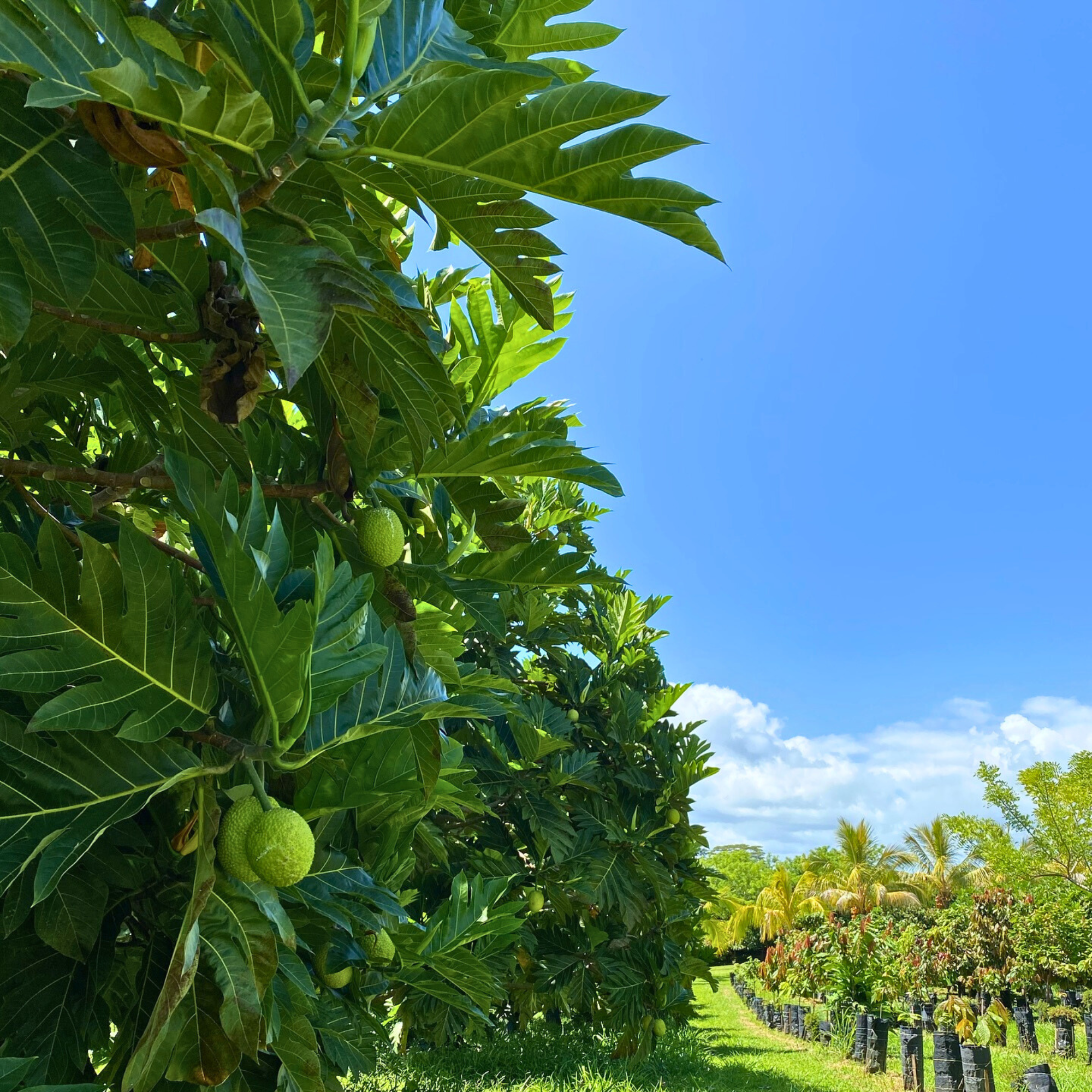
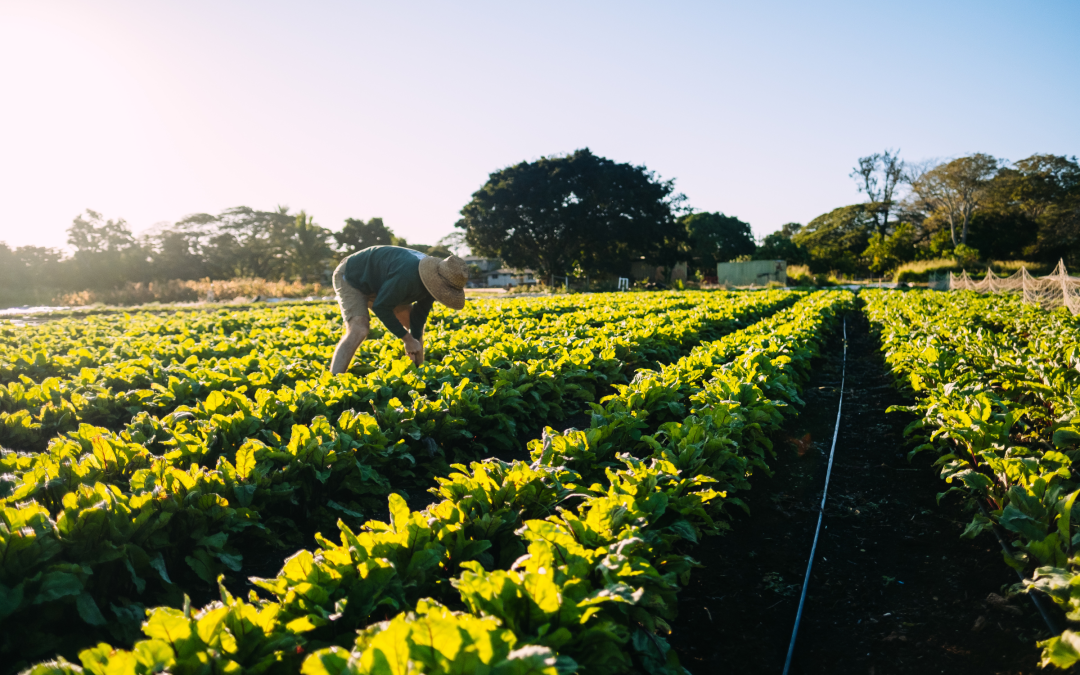
Hawai‘i Island farmer Tom Menezes has worked in local agriculture for 50 years as a farmer, UH extension agent and in other roles. He grows ‘ulu as part of an agroforestry system, where he alternates a single row of ‘ulu with four rows of cacao, over and over. He said the co-op makes his job more enjoyable because he can focus solely on farming, rather than trying to figure out where he’s going to sell each week’s harvest. He and his daughter have a chocolate business in Hilo called Mahi‘ai Made. | Courtesy: Mahi‘ai Made
How a Co-op Addressed ‘Ulu’s Challenges
The Hawai‘i ‘Ulu Cooperative was founded in the summer of 2016 by nine diversified Hawai‘i Island farms. Within three years, the co-op had created its first value-added products, opened two processing facilities on Hawai‘i Island and gotten its crops on public school menus.
The organization’s goal is to develop a sustainable ‘ulu industry in Hawai‘i. That means ensuring that farmers are the beneficiaries of the industry’s growth in an institutionalized way. Shapiro said that’s why the founding members pursued the cooperative model, which is meant to be member-owned, member-controlled and member-benefiting.
“When you build an industry, it often times starts with a farmer-led approach or a farmer-centric approach, but then as it becomes more successful, the farmers are the ones who will get squeezed at the bottom,” Shapiro said.
Co-op members meet annually, and each one has an equal stake in the organization. They elect a board of directors that sets yearly prices for how much the co-op will pay farmers for their harvests. That keeps pricing stable amid market changes and can help prevent undercutting or price gouging by individual producers. In fiscal year 2024, the co-op paid members $440,000 for their crops.
Other meaningful votes have expanded membership to O‘ahu, Maui and Kaua‘i counties and creating a second membership tier for farmers whose ‘ulu trees are not yet producing fruit.
Shapiro said that the co-op’s policies and procedures are designed so that a broad cross-section of the farming community can participate. New membership dues are low ($125), and the co-op doesn’t rely on its members to capitalize its operations and facilities. Instead, it applies for grants and loans and seeks non-member equity.
Many of the co-op’s members identify as Native Hawaiian or Pacific Islander and have a younger average age compared with the state’s overall farmer demographics. At press time, the co-op was still completing its analysis of its latest membership numbers, but in 2024, the average age of its members was 50, and 22% identified as Native Hawaiian or Pacific Islander. According to the U.S. Department of Agriculture’s latest census in 2022, Hawai‘i farmers have an average age of 61 and only 8% identify as Native Hawaiian or Pacific Islander.

Hawai‘i ‘Ulu Cooperative has nearly 200 members on Hawai‘i Island, Kaua‘i, O‘ahu and Maui and about 30 staff members. In its first year of operations, it processed about 20,000 pounds of ‘ulu. In the last year, that number rose to 230,000 pounds. | Courtesy: Hawai‘i ‘Ulu Cooperative
Today, the co-op is the biggest buyer of ‘ulu in the state, Shapiro said, but it’s still a few years away from reaching profitability. Once it reaches that point, profits would then be redistributed to members at the end of each year based on their crop contributions.
“We’re still actually not at the scale to be completely profitable on our own, just through our product revenues,” she said. “We are currently projecting that our break-even economy of scale will be around 1.1 million pounds of all crops, which is still a few years away.”
Shapiro added that the co-op structure doesn’t mitigate the difficulties of doing business in Hawai‘i, such as the high costs for production and trying to pay staff fair wages. The ‘ulu co-op’s starting wage is $18 an hour, and while it’s $4 higher than the current minimum wage, it’s still difficult for workers to live on that earning alone.

Emilio Ruiz-Romero of ResiRoots Café outside of a new processing facility for the Hawai‘i ‘Ulu Cooperative in Hanamā‘ulu. Members will drop off their harvests under the pavilion, and staff and volunteers will wash the fruit before bringing them inside to be cut, steamed, frozen and packaged. | Noelle Fujii-Oride, Overstory
More ‘Ulu in Hawai‘i
O‘ahu chef Kealoha Domingo grew up eating ‘ulu. His mother would cut the fruit in half, coat it with butter, brown sugar and cinnamon, and bake it in the oven.
Now the owner of Nui Kealoha, a catering business, he aims to honor the spiritual connection between food, the ‘āina and humankind. Part of that has involved creating dishes with ‘ulu and participating in a program to reintroduce traditional Hawaiian ingredients at Kamehameha Schools.
One of his early dishes was ‘ulu bites prepared the same way his mother prepared it. Many of the students would tell him that was their first time trying ‘ulu.
“I wouldn’t say everyone loved it, but as long as I get a handful of them that say, ‘Oh, Uncle, I really liked it,’ you know, (it’s) kind of like an opportunity to reintroduce something that their ancestors ate to their diet and hopefully change their perspective for the rest of their lives,” he said.
Domingo has been a longtime partner of the Hawai‘i ‘Ulu Cooperative and often relies on the organization to supply his ‘ulu. He’s even had the co-op ship ‘ulu to him for events in New York and Washington, D.C.
The cooperative wants to see more ‘ulu grown and eaten in Hawai‘i. Until recently, the organization was participating in a U.S. Department of Agriculture-funded program to help local farmers expand their agroforestry operations. It would have brought in up to $6 million for local farmers, but its funding was cut.
While the loss of funding is a major blow to local farmers, the co-op continues to focus on helping members’ ‘ulu trees reach full production. By 2035, the organization expects to process 1 million pounds of ‘ulu and another 1 million pounds of kalo, ‘uala and pala‘ai.
Shapiro said the organization is expanding its existing Hawai‘i Island facilities and looking at how it can build infrastructure on the neighbor islands. It currently uses other organizations’ facilities on Maui and Kaua‘i. On O‘ahu, ‘ulu is currently only sold fresh until the co-op can find a new facility.
A new facility will soon open at The Pineapple Store in Kaua‘i’s Hanamā‘ulu in partnership with ResiRoots Café, a Kaua‘i business that grows and processes kalo, cassava, bananas and ‘ulu. Kaua‘i has nine members, the second-most active island after Hawai‘i Island, Shapiro said.
The new facility is expected to cut, steam and freeze 1,000 to 3,000 pounds of ‘ulu a week, said Emilio Ruiz-Romero, who runs the business with his partner, Jade Andaya, and is a new co-op member.
“To me, it highlights the importance of commercial kitchens and food processing capacity, which is a huge barrier and limiting factor for agriculture in Hawai‘i and other industries, including ours,” said Chris Ka‘iakapu, the co-op’s agroforestry manager who lives on Kaua‘i. “You can’t just have all this supply and trees and all the farmers with nowhere convenient and stable for them to drop it off or sell it to.”
While Ruiz mostly farms kalo, he’s propagated over 450 ‘ulu trees and donated them around the island. He hopes to encourage those new ‘ulu growers to become co-op members as their trees mature and start bearing fruit.
He added that he appreciates that the co-op will commit to purchasing as much ‘ulu as farmers want to sell, rather than placing a cap on how much fruit they’ll accept.
“That’s hard to find and that really supports farmers,” he said.