Exposed spaces beneath lānai, eave vents with large openings, a bit of debris in the gutters, and some guinea grass or haole koa growing a few feet away from a home don’t sound like anything out of the ordinary on Kaua‘i.
But because its historic plantation camps are in areas that get little rain and are surrounded by desiccated vegetation, those things increase their risk of being harmed by encroaching wildfires. An ember from a few miles away can easily enter uncovered eave vents, travel into the attic and ignite the home’s insulation.
Kaua‘i County’s new Wildland Urban Interface (WUI) ordinance aims to mitigate that by reducing wildfire risk in the plantation camps through new requirements to harden newly constructed homes and better maintain surrounding vegetation.
“Being that these embers can travel so far during high wind events, we’re really making sure we focused on the actual built environment and how it can be calibrated to … it sounds strange, but the phrase is to live with fire,” said Ka‘āina Hull, director of Kaua‘i’s Planning Department.
Kaua‘i’s WUI ordinance impacts Kaumakani Village and Kaumakani Avenue, Numila, and Ka‘āwanui and includes additional coastal managed-retreat provisions for Pākalā Camp. It’s the first WUI ordinance in Hawai‘i, but similar codes have been implemented across the U.S. to better protect communities from wildfires.

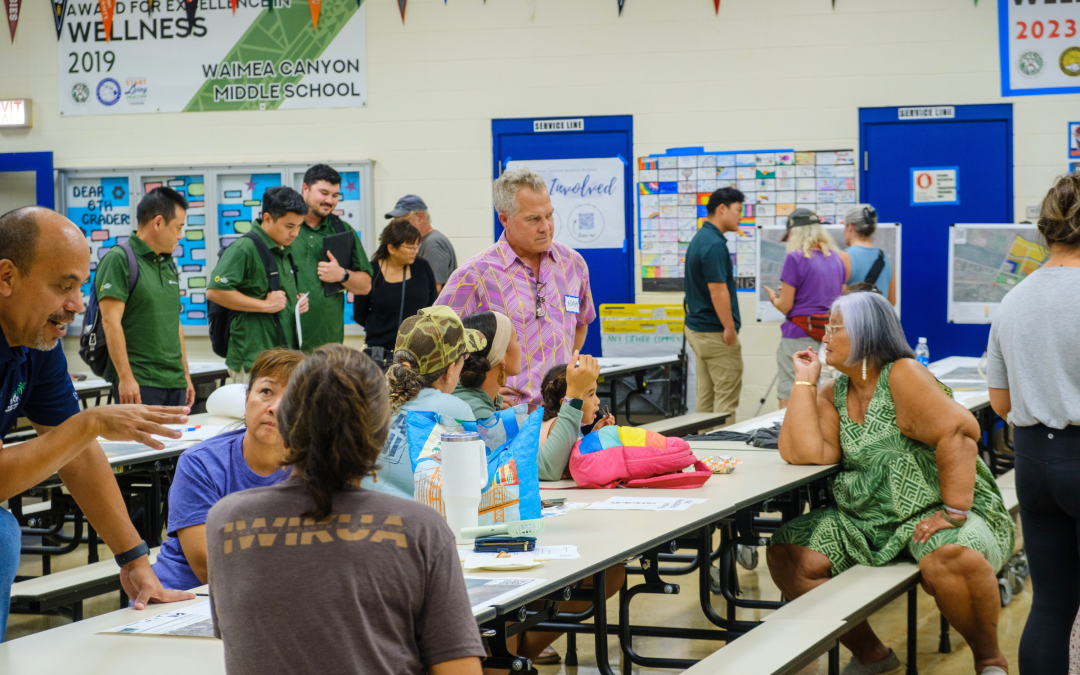
Members of Kaua‘i County went door-to-door in Kaumakani in July and August to talk with residents about creating evacuation plans, preparing emergency go-kits and staying informed during wildfires. | Courtesy: County of Kaua‘i
Wildfire Hazards
Several hazards make Kaua‘i’s plantation camps especially vulnerable to wildfires, including roadside and unmanaged vegetation and wind-driven fire spread during dry, trade-wind or Kona wind events, wrote Kaua‘i Fire Chief Michael Gibson and Administrative Battalion Chief Jayson Pablo in an emailed statement.
Older plantation camp housing can be more vulnerable to ember ignition due to their rooftop and siding materials. Additionally, narrow access and water supply in some camp neighborhoods complicate fire suppression and evacuation efforts.
“These factors together mean a relatively small brush fire can threaten many homes very quickly,” wrote Gibson and Pablo.
The department saw that last summer when a fast-moving brush fire threatened about 100 homes between Kaumakani and Hanapēpē and burned about 1,100 acres. One structure in Kaumakani Camp was destroyed, but the homes were untouched.
“What we learned from the Kaumakani and Hanapēpē fires is that no amount of firefighting resources can stop a large, wind-driven wildfire once it’s fully developed,” Gibson and Pablo wrote. “The real protection happens through defensible space, home hardening, community evacuation planning, and early evacuation when conditions turn critical. The new WUI standards give us the tools to make these preventive actions a normal part of how we build, maintain and live in high-risk areas.”

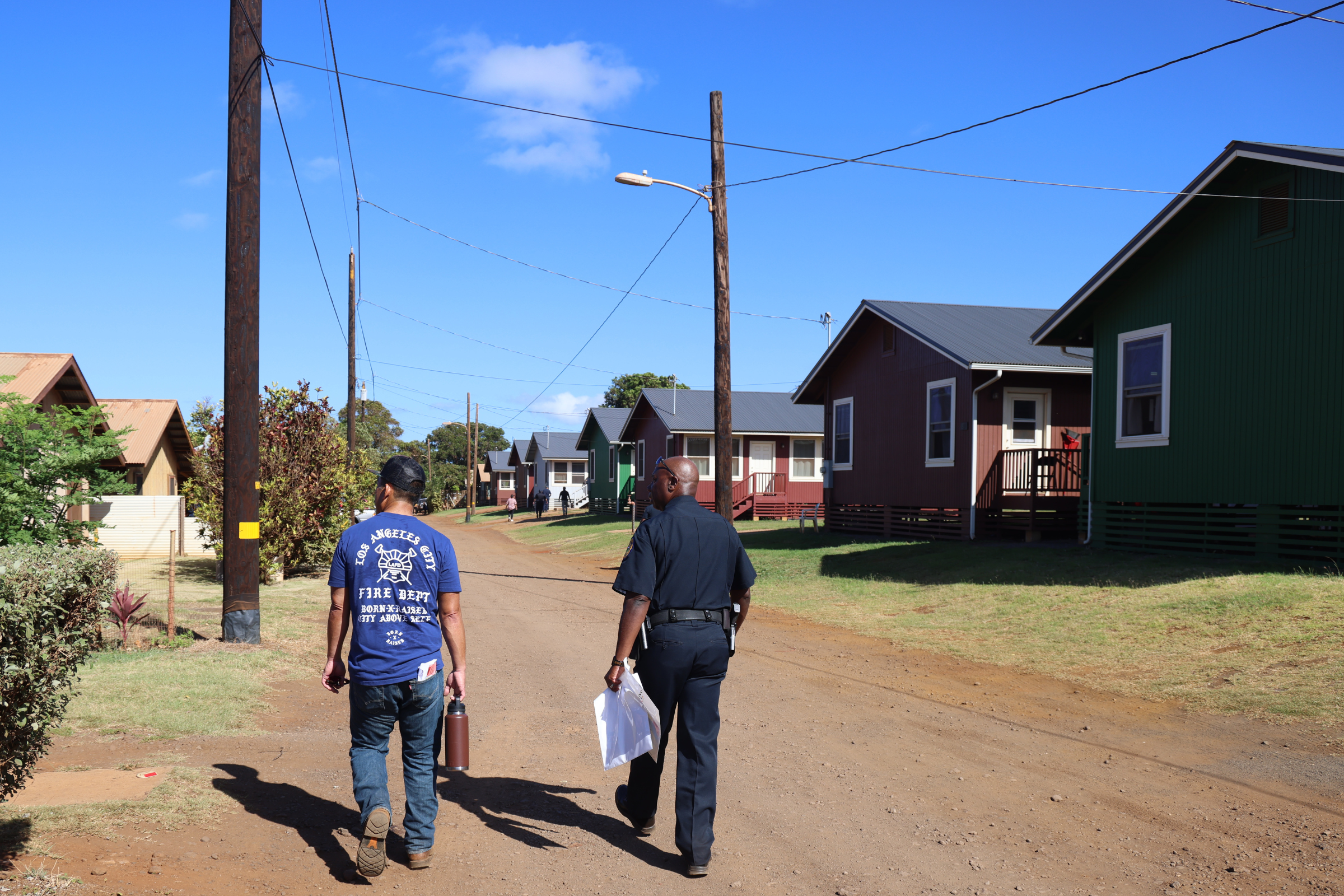
Kaua‘i’s WUI ordinance creates defensible spaces surrounding homes by reducing combustible vegetation to limit the ability of fires to transfer from open fuel to homes. Above, county and partner agency officials at a wildfire preparedness outreach event in Kaumakani. | Courtesy: County of Kaua‘i
Fire-Adapted Homes and Defensible Spaces
Despite what many think, walls of flame from wildfires aren’t the primary cause of home ignitions. Up to 90% of homes and buildings destroyed by wildfires are caused by wind-blown embers.
As a result, much of Kaua‘i’s WUI ordinance focuses on hardening plantation camp homes so embers can’t intrude into the structures and then spread.
Newly constructed homes, including rebuilds of existing ones, must have fire-resistant roofs made of metal or asphalt shingle, metal gutters and downspouts covered with non-combustible material, stronger windows, ember-proof vents and screened crawl spaces.
Metal flashing is also required on exterior walls where the walls connect to the ground, deck and roof. Otherwise, ember can linger in those corners and eventually ignite the wood, Hull said.
The material cost of these hardening elements is about $2,700 extra for a 1,000-square-foot, 3-bedroom home, according to a cost study prepared by Unlimited Construction for Kaua‘i County.
There must also be a 5-foot concrete band around the home—which must be always kept clear—and the house has to be at least 30 feet away from other structures.
Hull said that 5-foot space is crucial to maintaining a defensible area. It’s also the costliest new requirement. The cost study priced the concrete band at about $14,000.
The WUI ordinance also sets landscaping standards for all homes. Tree canopies, for example, cannot exceed 10 feet in diameter if located within 30 feet of the home, and fire-prone vegetation cannot exceed 18 inches within 100 feet.
One of the novel components of the code is that the plantation camp’s owners, Gay & Robinson and Brue Baukol Capital Partners, must hold a fire-adapted community workshop and defensible space clean-up event each year. The owners must try to have every household represented at the workshop.
The two companies have been supportive of the ordinance, Hull said. Both were consulted during drafting as the county was already in the midst of updating its zoning code for the plantation camps to allow for more homes to be built and deteriorating cottages to be rebuilt.
Howard Greene, vice president of Gay & Robinson, testified in support of the bill at a county council meeting and told Hawai‘i Public Radio that while the company agrees that the WUI ordinance is necessary, it hopes there can be flexibility with some of the new construction requirements.
Built Environment’s Role in Wildfire Resiliency
In September 2024, Hawai‘i’s Department of the Attorney General released its Lahaina Fire Incident Analysis Report, which found that some characteristics of Lahaina’s built environment—like how homes were constructed, the space between them and adjacent vegetation—likely contributed to the devastating August 2023 wildfires.
“All of us are in the business now of retrofitting poorly designed, unsafe neighborhoods and towns that were built at a time when wildfire risk was low, and that wildfire risk has basically moved in and grown up around unprepared and unsafely designed communities,” said Elizabeth Pickett, executive director of the Hawaiʻi Wildfire Management Organization, which helped draft Kaua‘i’s WUI ordinance.
WUI codes have been adopted in places like Austin, Texas; Boulder, Colorado; and California, often after major fires. But getting them implemented requires a lot of place-based modification based on the specific environment, the types of buildings being constructed and what communities will tolerate.
“They’re not cookie cutter,” she said. “That’s tricky part.”
She hopes to see other communities in Hawai‘i discuss and coordinate ways they could build wildfire resiliency into other fire-prone areas. Her organization has already received inquiries from development and construction professionals who want to incorporate wildfire standards into their projects even if they’re not required by law.
Hull said Kaua‘i County was approached by a large landowner to draft commercial building standards that include wildfire resiliency. The county will also be reviewing its built environment standards to see how it can better encourage property owners to shore up existing structures against wildfires.
Maui County is also about to do a deep dive into its codes with Community Planning Assistance for Wildfire and the Hawaiʻi Wildfire Management Organization, wrote County of Maui Planning Director Kate Blystone in an email.