Tea Hawaii & Company
Founded by husband and wife team Chiu Leong and Eva Lee, Tea Hawaii & Company grows tea in a temperate rainforest on the summit of Kīlauea Volcano.

Ami Mei
A Native Hawaiian-owned tea and wellness boutique based in Honolulu that specializes in matcha from Kyoto.

Treehouse Teas
A Native Hawaiian-owned boutique tea company in based in Honolulu that specializes in 100% Hawai‘i-grown teas and botanicals.

Volcano Winery
A family-owned winery founded in 1986 in Volcano. The business also grows Camellia sinensis and sells black and white tea, plus a tea wine.
Rainforests on the Kīlauea volcano are characterized by their towering ‘ōhi‘a and koa trees and verdant haupu‘u ferns. But on a farm at 4,000 feet elevation, you’ll find something unexpected under the canopy: rows of Camellia sinensis, also known as “true tea,” growing as an understory crop.
The leaves from the hardy, evergreen plants are used to produce green, black, oolong and white teas. Eva Lee and her husband, Chiu Leong, of Tea Hawaii & Company, have been growing Camellia sinensis since the early 2000s.
They are part of a small group of farmers, backyard growers and hobbyists cultivating Hawai‘i-grown tea. Many grow tea as a way to diversify their crops and produce the beverage in small batches by hand, focusing on the craft and quality.
“It’s been a very humbling experience of doing something that expresses itself within the arts, within agriculture, within the food system,” Lee said.
Tea derived from Camellia sinensis differs from herbal teas (peppermint, ginger, hibiscus, etc.) and māmaki, which has been gaining popularity as an herbal, non-caffeinated tea beverage. Māmaki is endemic to Hawai‘i and has been used for kapa, tools and medicine for centuries.

Tea, especially green tea, is rich in antioxidants. Research suggests that the caffeine and L-theanine in green tea may improve brain function. In the 1990s and 2000s, local researchers evaluated tea’s potential to help the state diversify away from the then-declining pineapple and sugar industries. Above, tea leaves dry out under the sun. | Courtesy: Tea Hawaii & Company
Characteristics Unique to Hawai‘i
Native to Asia, Camellia sinensis thrives in acidic soil with good drainage and in humid climates. That makes Hawai‘i—and particularly its higher-elevation, volcanic regions—ideal for tea cultivation.
Lee and Leong largely grow their tea in the existing native rainforest on their Volcano Village property, mimicking how it’s grown in Yunnan, China. Lee said that since the plants were started from seedlings, rather than seeds, they haven’t propagated themselves and spread in the forest, even after 20 years.
The forest ecosystem influences how their teas taste. When Lee and Leong still had a lot of invasive kahili ginger near their plantings, industry professionals told them their tea tasted rose-like. Another time, after a plume of ash had passed over their farm, which is a few miles away from Halema‘uma‘u crater, they were told their tea had a spicy quality to it.
“What’s going on in the climate, weather, surrounding conditions very much affects the plant’s uniqueness in its expression,” she said.
Brittnee Lau, owner of Ami Mei and Treehouse Teas on O‘ahu, said Hawai‘i-grown black teas generally have almost no astringency, but she cautions that there are many things that can influence how a tea tastes, including how it’s rolled and dried.
Her Treehouse Teas sells 100% Hawai‘i-grown tea, and she aims to bolster awareness of Hawai‘i-grown tea by selling to conscientious coffee shops and restaurants that will put it on their menus.
“I don’t think a lot of people know we grow true tea here,” she said.
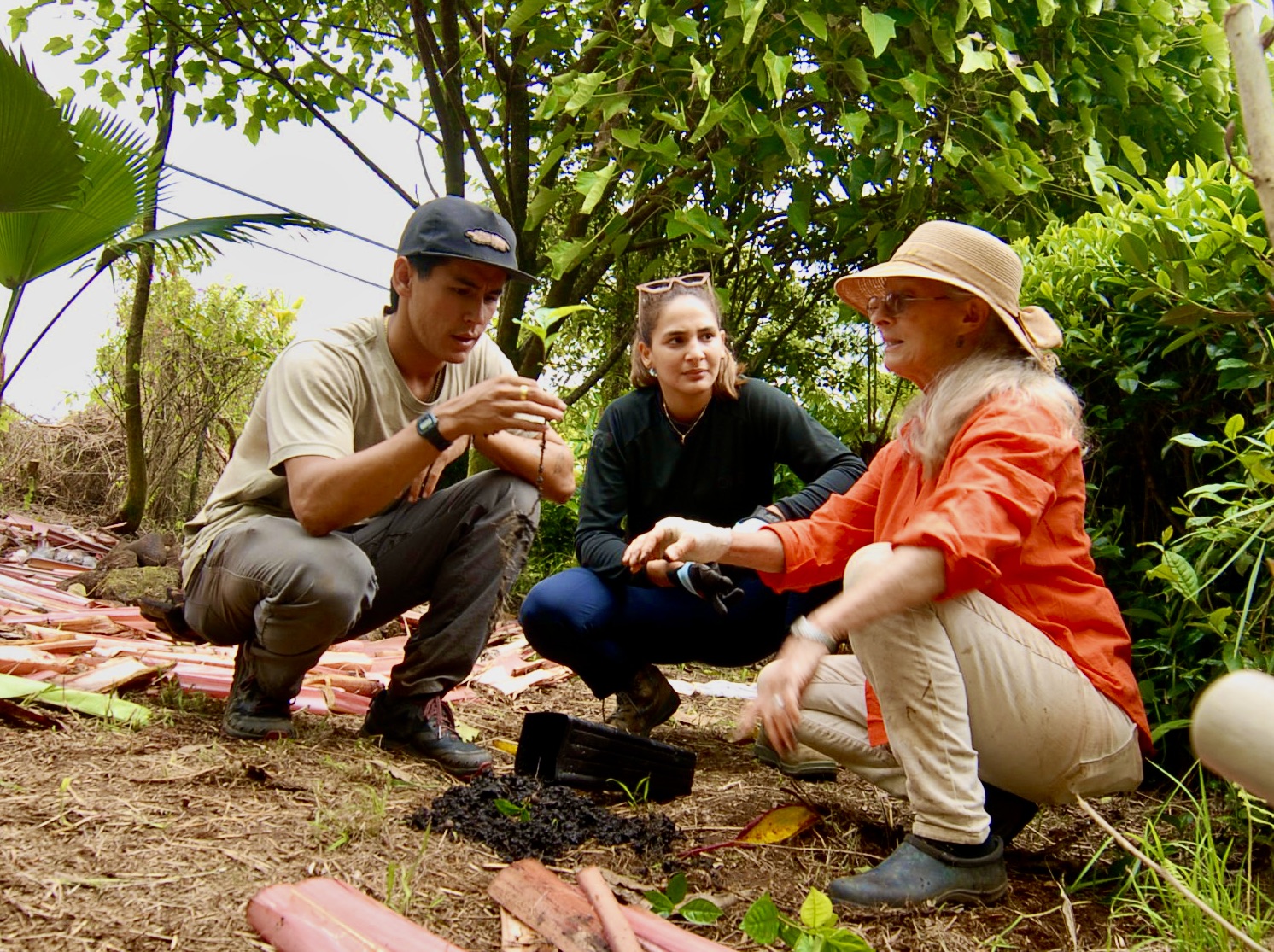
Big Island Tea has held five-day workshops for the last several years to teach the next generation of tea growers. The workshops have drawn attendees from around Hawai‘i, as well as from the continent and other countries. | Courtesy: Big Island Tea
Focus on Artisanal Tea
Hawai‘i is one of nearly 20 states that cultivates its own tea, according to “World of Tea” by Jane Pettigrew. There are about two dozen growers, though only 10 do it commercially, and most are on Hawai‘i Island, Lee said.
Some, like Volcano Winery, grow tea to diversify their crops. Alex Wood, the operations manager, said the winery has been growing Camellia sinensis since 2005 and today has a half-acre tea field.
Unlike Lee and Leong, who are located five miles away, Volcano Winery grows its tea under full sun and in an area with a lot of lava rock. It produces about 150 to 200 pounds of finished tea per year.
One of its products is a premium, loose-leaf black tea. Wood said leaves for that tea are hand harvested because the aesthetic is a big part of why the finished product carries a higher price.
Volcano Winery also makes and sells a tea wine made from black tea and its flagship macadamia nut honey wine, plus a loose-leaf white tea that won first place in a national commercial tea growers competition in 2015.
Creating tea is very much an artisanal craft. Eliah Halpenny started her tea farm in 2001 with her husband and spent nine years trying to perfect her whole-leaf black tea recipe.
“I have two books of all the tea I made in trying to get it right,” she said.
Her business, Big Island Tea, hand harvests and processes about a kilogram of tea leaves at a time—only about 20% of that remains in the finished tea. It’s a labor-intensive process, but it gives her and her workers the ability to be intentional about each leaf they pick and strive for perfection in the final product.
Retail prices for Hawai‘i-grown tea vary widely. Lau said that prices can range from $30 to $40 per ounce—that’s about nine to 10 cups of tea, depending on the type (black, green, etc.) and how it’s brewed.
But some tea prices far exceed that amount. Halpenny said Big Island Tea focuses on ultra-premium tea. The retail prices for its black and green teas are nearly $100 per ounce.
“I decided we better grow the best tea possible because in order to make it economically feasible, we need to ask big dollars for our tea,” she said. “We don’t pay our workers $6 a day. We pay our workers $25 an hour. We can’t do that if we sell our tea for $40 a kilogram.” Its wholesale price, $1,750 for a kilogram, breaks down to nearly $50 per ounce.
“I think for Hawai‘i, it never really could reach that commodity level and that big scale (that sugar saw) because globally it can be done so much more inexpensive. So what the tea industry in Hawai‘i has settled into, it has a lot of hobbyists and small farmers, and it seems like the farmers are incorporating that into other things they do.”

Eliah Halpenny and her conservation geneticist husband, Cam Muir, started their tea farm in 2001 with 10 seeds and now have 7,000 to 8,000 tea plants. Located on the slopes of Mauna Loa, they re-established a native cloud forest and planted Camellia sinensis as an understory crop. “We put his understanding of science and my love of horticulture together and we realized if we wanted to grow tea, we should grow it the way it grows in nature,” she said. | Courtesy: Big Island Tea
Early Support for Hawai‘i-Grown Tea
Camellia sinensis was introduced to islands in 1887, and various, unsuccessful attempts were made to commercialize it, including by some of Hawai‘i’s major sugar firms.
Seeds were planted for Hawai‘i’s modern tea industry by Francis Zee, a horticulturalist with the U.S. Department of Agriculture (USDA), and researchers at the University of Hawai‘i’s College of Tropical Agriculture and Human Resources (CTAHR) beginning in the late 1990s.
Their research on Hawai‘i Island helped to establish cultivars that could easily be grown in Hawai‘i and resulted in revised horticultural and processing techniques.
They and other industry pioneers hoped that tea would become a specialty industry akin to Hawai‘i’s world-famous coffee industry, rather than compete against the global tea market.
“There’s no way Hawai‘i, we knew this, could compete with the world volume of tea,” Halpenny said. Tea has high production costs because of the labor involved, and global commodity prices are too low to sustain Hawai‘i operations. Instead, they sought to create a niche market of high-quality, small-scale tea.
In the early 2000s, the now-defunct Hawaii Tea Society was created to serve as a bridge between the research institutions and the private sector. Over the years, it ran tea plant distribution and educational programs and conducted a growers’ tea competition event.
Investments into Hawai‘i’s tea industry continued through the mid 2010s. Byron Goo, co-founder of Tea Chest Hawai‘i, which manufactures and sells 100% Hawai‘i-grown tea, said a USDA grant helped his company train 25 farms on four islands on how to grow tea.
He targeted existing commercial farms wanting to diversify their crops because they already had labor and land, whereas earlier efforts had focused on backyard growers.
But he doesn’t know how many of those farms are still growing tea today, and he continues to find it difficult solely sourcing enough Hawai‘i-grown tea for his company’s products.


Volcano Winery cultivates tea on a half-acre on the slope of Kīlauea Volcano. They began by planting stem cuttings from the USDA and UH. It generally takes about five years for tea plants to reach maturity when planted from cuttings. | Courtesy: Volcano Winery
Industry Bottlenecks
At 25 years old, it’s unclear how much tea is being produced in the Islands. Some growers and manufacturers said there’s room for the industry to grow, but it faces challenges with reaching economies of scale and encouraging a new generation of farmers to continue the craft.
Goo said that, for the most part, tea growers harvest, process and then sell their own tea, rather than collaboratively working together to reach economies of scale. In other tea-growing regions, for example, small-scale farmers will form cooperatives to build processing facilities and share resources.
“In any kind of business, 70% of what we do is the same—sales, distribution, marketing, supplies,” he said. “What you don’t need to do is share your 30%, which is what makes your tea different.”
Tea Hawaii & Company processes tea for three other Hawai‘i Island farms, in addition to its own, producing about 150 kilos of finished green, white, oolong and black tea a year. It uses machines to help process some of that product.
Offering this service to other farms requires having enough revenue to purchase and then operate the equipment, Lee said, and not all growers have enough scale to afford the service and find it worthwhile.
But with fewer growers and less new investment in the industry, some say local tea has plateaued.
“It’s stagnant,” Goo said. “There’s no new investment or innovation going into it. I think over time it’ll drop down.”
The industry has already seen some early growers close their operations after they retired or sold their farms—a challenge that plagues the entire farming industry. Kaua‘i, for instance, used to have one or two tea growers, but today there aren’t any, Lee said.
Untapped Demand
Some, like Halpenny and her husband, are focused on preparing the next generation of tea growers. They’ve offered a five-day course for the last several years to teach new farmers how to grow and process tea.
Those courses have attracted prospective farmers from around the islands, as well as from the continent and other countries. This year’s course will take place on their farm at the end of July, and Halpenny hopes to get a couple more participants.
Farms like hers are part of Hawai‘i’s first generation of tea growers; they will need new young farmers to take over and continue the trade, she said.
Getting more mechanized processing equipment may also help. Tea Hawaii & Company recently received a $100,000 USDA grant to get a commercial tea steamer, which will allow for the creation of Japanese-style steamed green tea and matcha, and packaging equipment. The equipment would help local tea growers introduce new products to the market and increase production.
Lee said she’s hoping to receive the grant funds in July. However, prices have significantly increased since she applied for the funding at the beginning of 2024, so she may not be able to get both pieces of equipment.
She said getting this type of equipment would help the tea industry work more cooperatively. Her goal is for the equipment to help at least nine local tea farms.
“Here was an opportunity to at least go in part in that direction of co-op, collective, and now we’re faced with another hiccup,” she said.
In the meantime, she’s exploring Hawai‘i-made matcha and whether there’s willingness to pay higher prices for this locally made product. People can pay 10 cents for a gram of matcha made elsewhere, and it’s hard for Hawai‘i growers to do it for less than 27 cents a gram.
Nonetheless, Wood said the industry has a lot of potential for growth because there’s such high demand for locally grown tea and because the plant is adaptable to a variety of climates.
“The supply has not met the demand,” he said. “I think there’s a huge potential of markets that haven’t really been tapped.”

Big Island Tea
Established in 2001, Big Island Tea is located at 3,000 feet above sea level on the northeast slope of Mauna Loa. The business produces ultra premium single-batch whole leaf green and black tea and offers five-day tea farming workshops.

Tea Chest Hawai‘i
A Honolulu tea manufacturer and retailer selling 100% Hawai‘i-grown tea. Founded in 1995, Byron and Satomi Goo began their evolution as tea makers, drawing on their Hawaiian, Chinese and Japanese heritage to source and craft teas for the modern table.