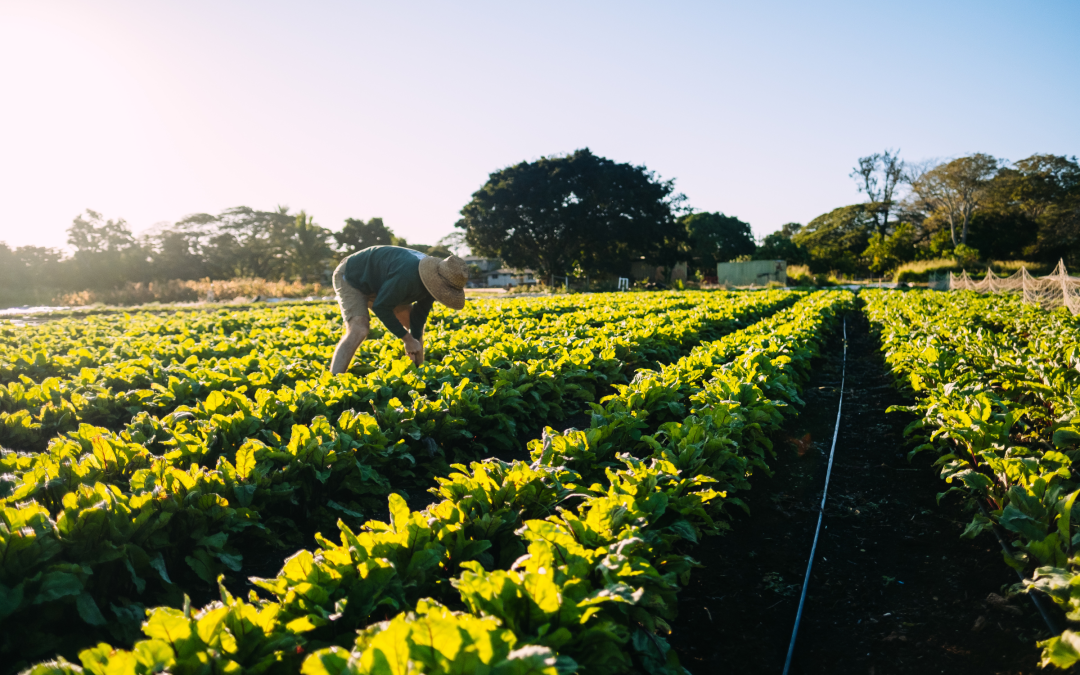
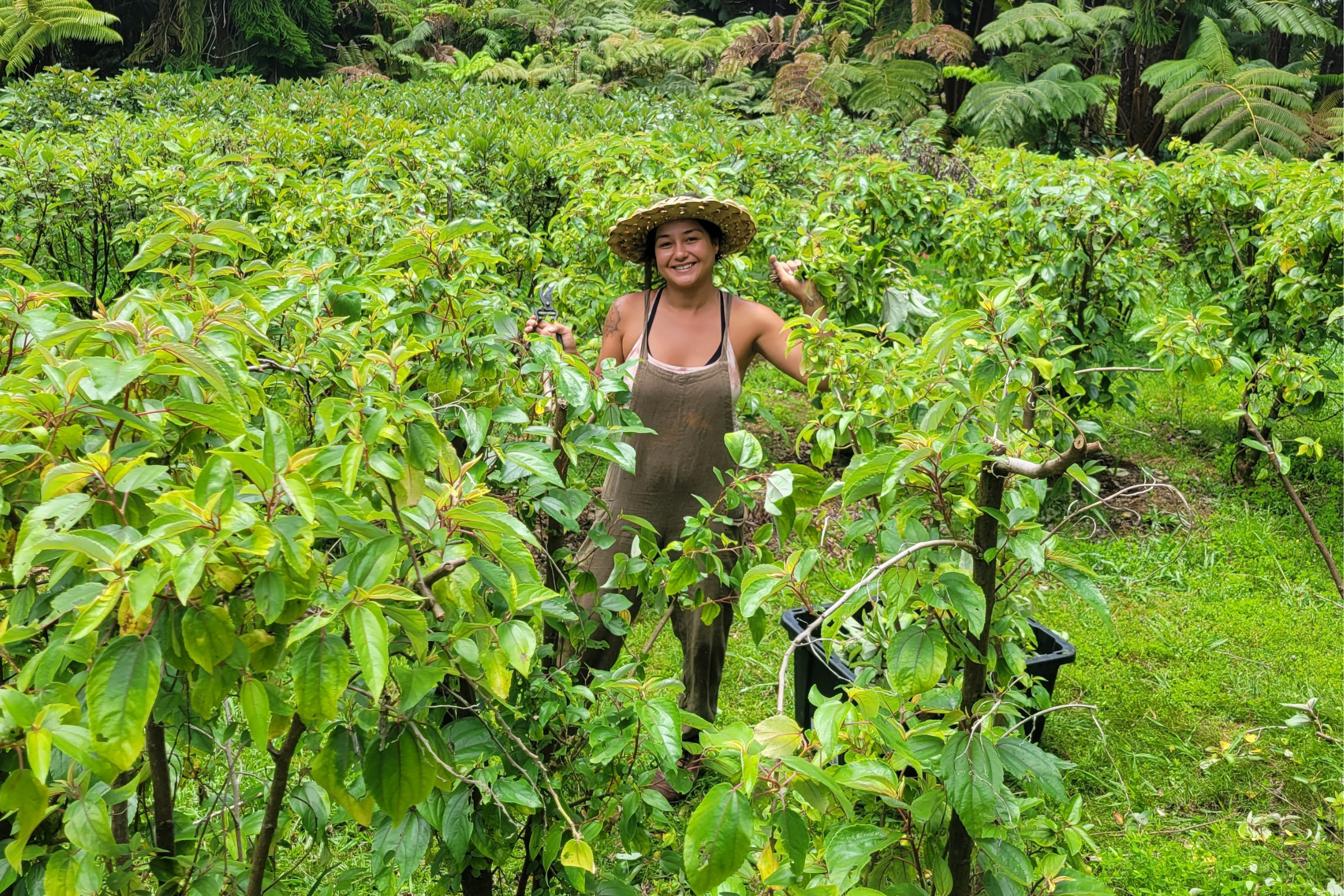
Koh Ming Wei was clearing some of her Puna property to plant māmaki when she had to leave amid the 2018 Kīlauea eruption. After returning home a few months later, she was surprised to see three perfectly aligned rows of māmaki rising through the soil.
There was once a large māmaki plant, so seeds must have already been in the ground when she began clearing, she said. As her plants matured, she sold her harvests to Hilo-based herbal tea brand Shaka Tea, which closed at the end of 2024.
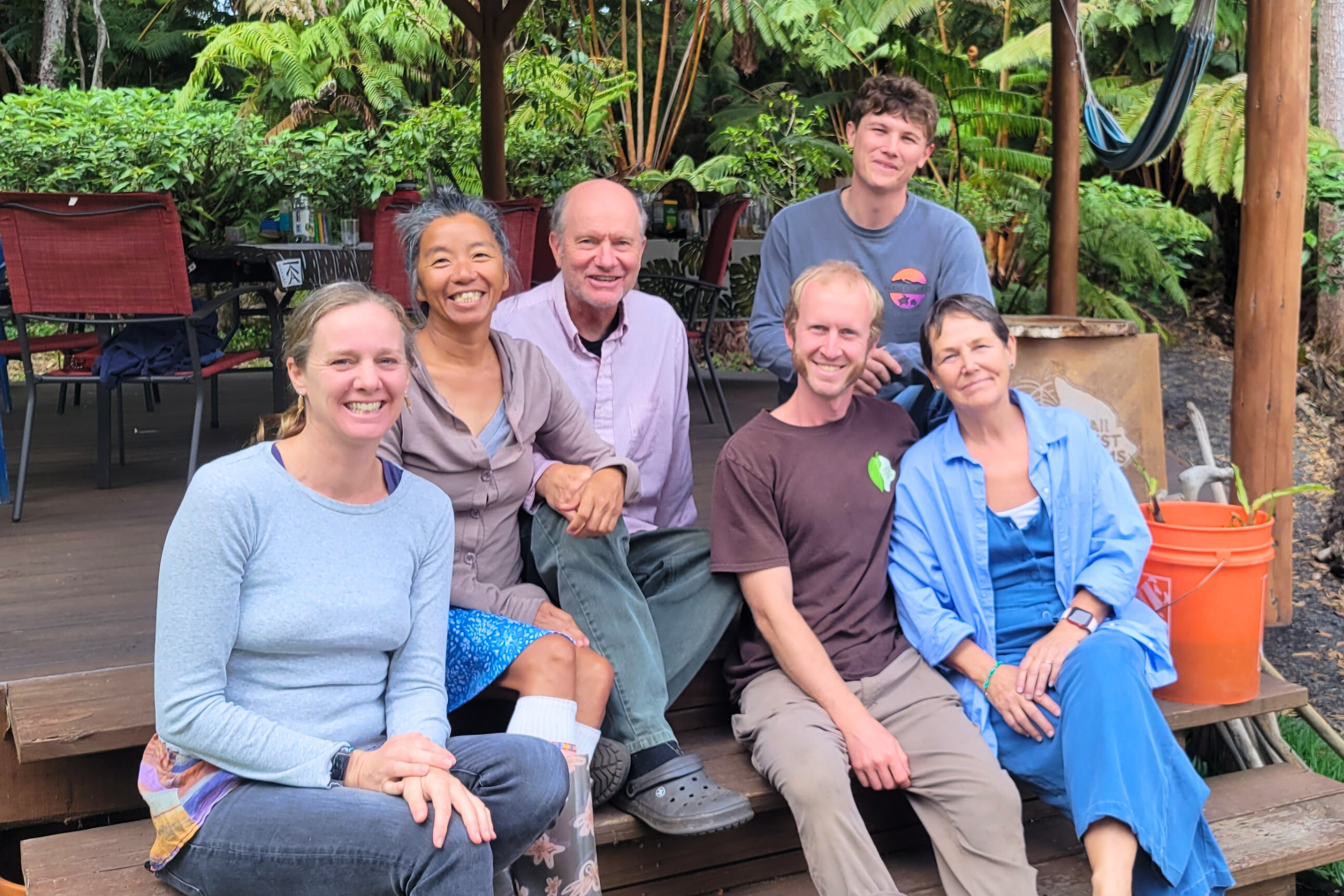
While Shaka Tea was a major māmaki buyer, it wasn’t very accessible to smaller, family growers, so Koh and a handful of māmaki growers and a cooperative development specialist created the Hawai‘i Māmaki Cooperative in summer 2023.
“We didn’t want to stand for profit or money,” she said. “We wanted to stand for healing. The models of those businesses of the world, it is what it is, it’s a business. The bottom line is going to be business. Whereas we felt our bottom line has to be healing.”
Agricultural cooperatives are businesses that are controlled by members and operate for their collective benefit, rather than outside investors or the benefit of individuals. They have a long history of helping local food producers pool resources, share risk, preserve market access and magnify their collective influence.
Today, as 85% to 90% of Hawai‘i’s food is imported, supporters of this model argue that co-ops can empower farmers to democratically control and sustain their respective local farming sectors, strive for shared prosperity, and prioritize local food systems over global supply chains.
Some say this model especially fits Hawai‘i’s Indigenous crops, which shouldn’t be monopolized by a single business. In addition to māmaki, some ‘awa and niu producers are also interested in the co-op model.
“I think it’s an important time for everyone to learn about the cooperative model, especially with seeing how things are working in the bigger picture and how in the bigger picture, unfortunately, is pretty extractive and a zero-sum game where you win or you lose,” Koh said.
A Healing-Focused Cooperative
The Hawai‘i Māmaki Cooperative is still finalizing its functions and structure, but the idea is to help members with production, processing, marketing, education and research—like the nine-year-old Hawai‘i ‘Ulu Cooperative. The two co-ops are working on an agreement to share processing facilities since their crops have different peak seasons, Koh said.
Endemic to Hawai‘i, māmaki has been used for lā‘au lapa‘au and for making a type of kapa for hundreds of years. The fast-growing shrub is also the host for the pulelehua (the native and endangered Kamehameha Butterfly) and helps with ecosystem restoration.
The māmaki co-op’s co-founders believe the collective voice of a co-op and the inclusion of small farmers, local healers and other voices is the best avenue to ensure that growth and distribution of māmaki is not seen as commercial exploitation but rather appropriate sharing of Hawaiian culture.
“Because we’re dealing with a healing plant, all our co-op actions have to be healing,” Koh said. “Like if the plant is setting the values for your co-op, the number one thing for māmaki is it’s restorative, it’s regenerative, it’s healing, so all the co-op work has to follow suit.”
That’s meant that the producer co-op is looking at how it can also function as worker co-op—where employees own and manage the business—plus how it can give a portion of its best māmaki to lā‘au lapa‘au organizations on Hawai‘i Island to then pass on to their patients. Worker co-ops already exist in the local agricultural sector, such as Māla Kalu‘ulu, which aims to restore ancient ‘ulu agroforests.
The co-op also plans to give māmaki a voice via a potential kūpuna advisory board that would be consulted for major decision-making. That means māmaki would be treated like a member—in a co-op, each member has one vote. Koh said this is also meant to help address concerns people have about māmaki being a commodity in light of the plant’s increasing popularity as an herbal tea beverage.
Additionally, the co-op is exploring how it can change the way growers are paid for their harvests. Shaka Tea, for example, would take growers’ harvests, process them and then pay growers for the dried leaf amount. Sometimes, not all leaves would be dried due to quality control issues, so only bigger farms would really benefit.
“Can you imagine aunties who only have 10 or 20 trees and just want to do something, they can’t enter the market,” Koh said. “So with the co-op model, if you only want to bring us five or 10 pounds wet, yes, mahalo nui.”
Paying for wet leaves—what farmers harvest—would ensure that growers aren’t penalized for quality issues that occur during processing. For example, a processing member could have an accident or a machine may malfunction—things that growers have no control over, wrote Wrenn Bunker-Koesters, a co-op co-founder and former Shaka Tea employee, in an email.
While the co-op plans to handle processing, it still will have quality standards for accepted harvests. That’ll be important especially if the co-op ends up supplying large beverage companies that inevitably have higher and higher standards, wrote Grant Ferrier, one of the co-op’s co-founders, in an email.
“This will be one of our ongoing challenges to balance the small farmer ethos with the commercial rules of mainstream distribution,” he wrote.

How Co-ops Support Farmers and Ranchers
Co-ops have been part of Hawai‘i’s agricultural industry for decades. Ginger, egg and guava co-ops, for example, helped set market prices so that individual farmers could benefit from stable and fair pricing. And supply co-ops provided access to affordable farming supplies; one continues to operate on Moloka‘i.
“Everybody tried do one co-op,” said Michael DuPonte, an emeritus extension agent with the University of Hawai‘i’s College of Tropical Agriculture and Human Resilience.
He spent 30 years working in the East Hawai‘i region and helped several livestock and producer co-ops. Co-ops used to be more popular in decades past as they were used as a tool by UH extension staff and The Kohala Center to encourage producers to work together to address a shared problem or need, he said.
The Hawaii Cattle Producers Cooperative Association was created in 1984 after some local feedlot closures forced ranchers to seek an alternative market for their cattle. Since the late ‘90s, the organization’s main function has been to collectively ship members’ cattle to the continent for finishing and processing, said Betty Spence, the co-op’s manager who has been with the co-op in various positions since 1997. Today, the co-op has 14 members on Hawai‘i Island, Kaua‘i and Maui.
“They look at the co-op for the convenience because we will book with Matson, we will make the logistics, their arrangements for arrival on the mainland for trucking and getting it to a stage facility,” she said.
The co-op operates on an at-cost basis, meaning it will return any surplus earnings or profits to its members on a patronage basis. While Hawai‘i’s cattle industry has faced challenges with droughts, rising expenses and changing market dynamics over the decades, the co-op has been able to do this many times in the past, she said.
Vacuum cooling co-ops have helped small farmers share cooling and cold storage facilities. The Kamuela Vacuum Cooling Co-op was created in 1964 and has two vacuum cooling chambers, two walk-in refrigerators, a plug-in site for refrigerated trailers and a loading dock for refrigerated containers.
“It would cost a lot for someone to just do it on their own and use it a lot,” said Stennis Hirayama, the co-op’s president and a fourth-generation farmer with Y. Hirayama Farm. “To have it worthwhile, you’d have to produce a lot of produce.”

About forty minutes east, the 40-member Hāmākua Agricultural Cooperative was created in 1994 to become the sublessor for former sugar lands so that displaced workers could obtain farmland. Overstory was told the co-op’s board of directors was not yet ready to provide an interview, but the co-op said it currently holds state leases for 800 acres that is subdivided into smaller parcels ranging from two to 20 acres, enabling smaller, family-run farms and ranches to lease from the state.
Water co-ops have helped farmers maintain access to critical infrastructure. On Kaua‘i, they’ve helped farmers and ranchers oversee plantation-era water systems, such as in Moloa‘a, Kekaha and East Kaua‘i.
The East Kaua‘i Water Users Cooperative was created in 2002 after Lihue Plantation, which operated the East Kaua‘i Irrigation System, closed and the state-owned system was to be shut down, said Jerry Ornellas, a farmer who served as the co-op’s president from 2002 through 2019.
Types of Agricultural Co-ops in Hawai‘i
Generally, Hawai‘i’s agricultural co-ops can be organized into the following categories:
- Marketing: Help aggregate, process and sell harvests to achieve better prices for their crops. Ex: Hawai‘i ‘Ulu Cooperative
- Land: Collectively own or lease land for their members to farm. Ex: Hāmākua Agricultural Cooperative
- Worker: Employees collectively manage and share in the success of the organization. Ex: Māla Kalu‘ulu
- Utility: Jointly manage their own water, power and other essential systems. Ex: Kekaha Agriculture Association
- Supply: Food producers band together to buy the things they need to farm (seed, feed, fertilizer, equipment, etc.), often at better prices since they’re collectively aggregating their purchases. Ex: Hikiola Cooperative
“Our objective was to keep the water flowing. And since there was a vacuum there, we just filled that vacuum until the (state) agency would take it on.”
The co-op shut down at the end of 2019, and the state has since resumed control of the water system.
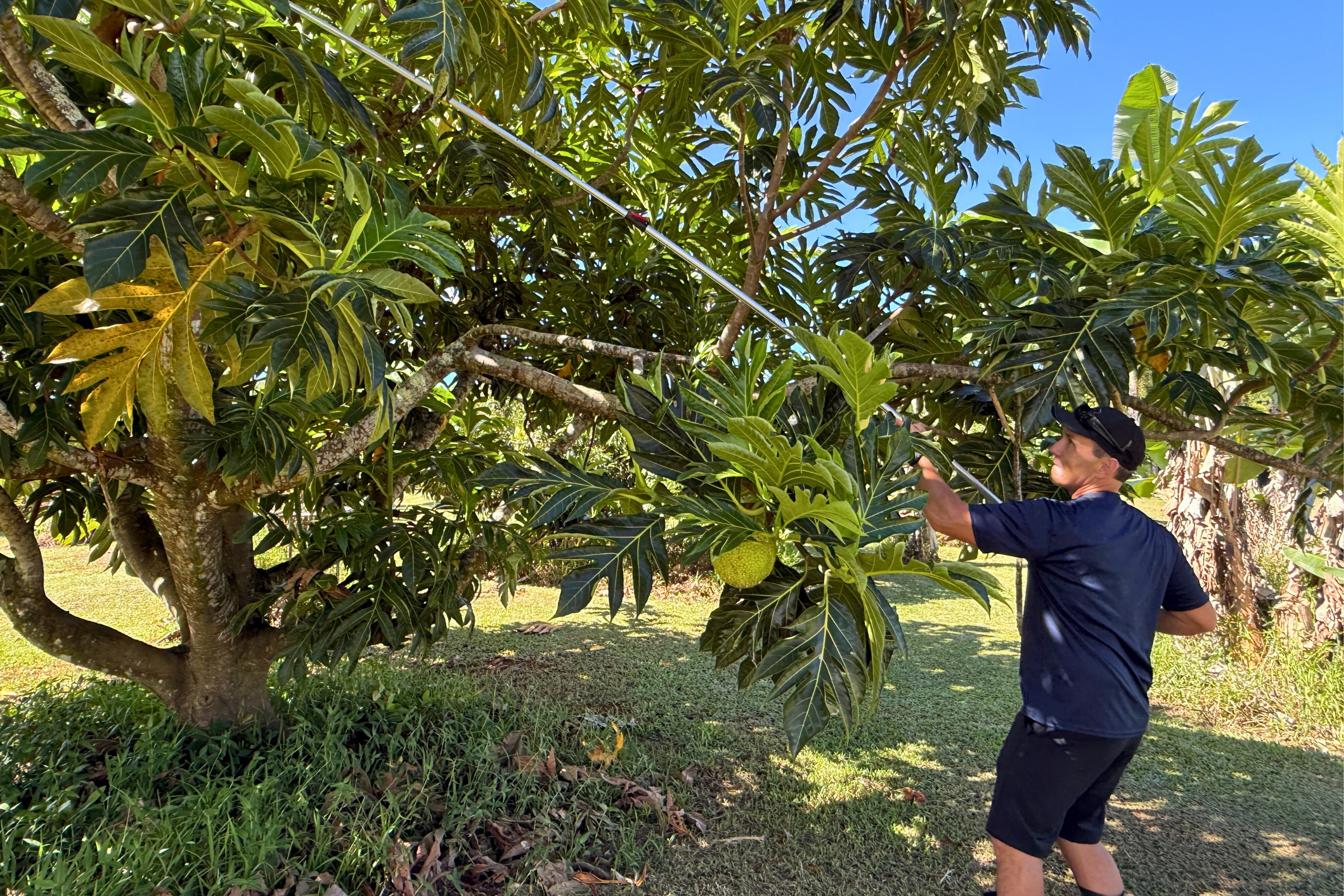
Perhaps the most well-known modern co-op, the statewide Hawai‘i ‘Ulu Cooperative was created in 2016 and today processes and sells its nearly 200 members’ ‘ulu, ‘ulala, pala‘ai and kalo. The co-op has helped build Hawai‘i’s ‘ulu industry and enabled ‘ulu to reach more kitchens and tables.
Damien Ventura, a farmer on Kaua‘i, joined the co-op at the end of 2024. He was inspired to join by his neighbor, who had a large ‘ulu orchard, and saw the benefits when he needed to sell a large harvest. ‘Ulu ripens within days of harvesting, so it needs to be sold quickly or processed to extend its shelf life. He’s since benefitted from having a stable buyer for his harvests and from the co-op’s technical assistance to improve his cultivation.
“You just deliver that raw product and they’ll take care of it for you, so, I mean, for growers, it’s a dream,” he said.
Growing Interest
In May, local co-ops from various sectors and those interested in this model met at the University of Hawai‘i at Hilo for Hawai‘i’s first statewide cooperative gathering.
Kelly Teamey helped organize the gathering. She’s a co-founder of Enlivened Cooperative, a worker-owned eco-social learning organization, and previously worked as a cooperative development specialist at The Kohala Center. She said there were 10 established agricultural cooperatives present, plus another 11 collectives that are exploring this model.
Keoni DeFranco, managing director of ‘Āina Foundry at Purple Mai‘a Foundation and another event co-organizer, said attendees discussed how co-ops are conceptually similar to Hawai‘i’s ahupua‘a community stewardship systems. They’re also a way to realize a more regenerative economy.
“I think in general people are realizing that the problems we’re having with our economy are structural,” said state Rep. Ikaika Hussey, who attended the gathering and is working on legislative proposals around worker cooperatives and community-based agricultural cooperatives. “What we need to solve for is how to make our economy more equitable and more democratic.”
Chris Ka‘iakapu is considering whether a co-op could work for coconuts. Based on Kaua‘i, he works for the Hawai‘i ‘Ulu Cooperative as its agroforestry manager and has seen how the ‘ulu co-op’s model could be replicated, but he recognizes local coconuts would have to compete with imported prices—something ‘ulu doesn’t have to do.
Not a Silver Bullet
“Co-ops are a beautiful thing,” said DuPonte. “Whoever thought of them gets an A-plus in my book, but to maintain them and get them established now is a lot harder than it was 20 years ago. It’s an opportunity if you can find the right commodity and the right people that can do the work.”
Farmers, he and others said, are notorious for keeping to themselves and working independently.
Hawai‘i Island farmer and Hawai‘i ‘Ulu Cooperative member Tom Menezes was part of ginger, guava, banana and kalo co-ops in the ‘80s and ‘90s. They were created to help control market prices, but they failed when individual producers would try to undercut each other or when foreign countries became major competitors.
At the end of the day, a co-op is still a business and must face the economic realities of operating in Hawai‘i. The Kamuela Vacuum Cooling Cooperative is facing that challenge now. Its members contribute to the co-op’s operation costs through membership fees and charges for each pallet that uses its facilities. Fewer members has meant less income, so it’s been a struggle to keep the co-op afloat, especially given its high electricity expenses and the costs to repair any equipment that breaks, said Hirayama.
The co-op had closer to 10 members and two employees to operate the facility when his father was part of the co-op. Today, the co-op has six members and no longer has enough income to support a staff position, so members are responsible for doing their own vacuum cooling.
“You always got to keep in mind that just because a cooperative exists doesn’t mean it’s going to be profitable,” Ornellas said, adding “it’s not a silver bullet. It’s not going to solve problems that are insurmountable. There is the economic reality.”
In other cases, declining membership led to closures. The Maui Farmers’ Cooperative Exchange, for example, closed in 2017 after 74 years. The co-op aggregated members’ lettuce, onions, cabbage, broccoli and other produce and sold it to various vendors on a commission basis, saving farmers the time and trouble of finding their own buyers. The co-op also shipped produce to Honolulu.
Howard Hashimoto, a Kula farmer and former long-time co-op member, said the co-op ultimately closed because the next generation of members’ farms didn’t want to continue farming.

Filling Members’ Shared Needs Long-Term
Those interested in pursuing this model need to be clear about how they’re going to fulfill their members’ unmet need and maintain service over the long-term or else they’ll become irrelevant, said Dana Shapiro, CEO and co-founder of the Hawai‘i ‘Ulu Cooperative.
“Just learning from some of our old-time farmers that have been in numerous co-ops in Hawai‘i over the last four or five decades, that is kind of the story of co-ops ending, of co-ops dying,” she said.
She added that co-ops are not a panacea and there are many ways to solve the same problem. A co-op was the right fit for ‘ulu in part because of Shapiro’s experience with the model. A co-op would also ensure that farmer-members remain the primary beneficiaries as the industry grows, more so than a nonprofit, she said. But at the same time, the co-op is still several years away from reaching profitability and being able to redistribute profits to members.
“The co-op path is a very challenging path,” Shapiro said. “You sort of have the best of both worlds but also the worst of both worlds in terms of the challenges that come with being a co-op compared to a typical for profit or nonprofit.”
A Co-op-Inspired Concept to Increase Household Food Security
Punalu‘u farmer Danny Bishop has been involved in efforts to strengthen food security and food sovereignty for decades. For the last 10 years, he’s been thinking how a co-op inspired concept can help increase household and community food security.
His idea is to have self-governing farmers’ clubs (or community-based subsistence agricultural co-ops) made up of community members who would collectively grow food on two, five or 10 acres of public lands. They could sell their harvests for some income, but the main point is to augment their own food supply.
“Co-ops is a way for people to engage without high financial debt and without stressful time management,” he said. “By sharing the load, you aren’t under a lot of stress to produce because money is not the priority, the nutrition is the priority and the engagement with the environment and like-minded people.”
His hope is that these clubs would grow canoe crops. While they’re sold for lower prices and have longer cultivation periods, they were a dietary cornerstone for early Hawaiians.
Bishop is working with Rep. Ikaika Hussey on a bill that would encourage state and county agencies to weigh the nutritional value of crops grown and how one’s farming practices will benefit the land more heavily than business plans when reviewing land lease applications. He added that he’ll soon be convening a committee of like-minded friends to help him solidify his concept.
“We’re trying to huli that selective process,” he said. “The first question that will be asked is what do you want to grow, what is the nutritional value of your crop? The criteria is what is the long-term effect of your farming practices on the land, so that’s the perpetuity idea, and the sustainability idea. The third question to be asked is what is the potential monetary return for your crops?”