‘Aha Wai O Maui Hikina
Also known as the East Maui Regional Community Board, ‘Aha Wai O Maui Hikina is concerned with the Nāhiku, Ke’anae, Honomanū and Huelo license areas and shall investigate, acquire, manage and control water collection and delivery systems with staff that consists of a regional director, grant writers, community liaisons and water system technical analysts.
East Maui Water Authority
In November 2022, Maui County residents voted to amend the Maui County Charter and voted in favor of establishing the Maui County Community Water Authorities and an East Maui Regional Community Board.
The EMWA and its ‘Aha Wai O Maui Hikina are tasked with creating and implementing watershed management plans, acquiring and managing water systems and leases, and managing the distribution of water under the authority’s control.

Alexander & Baldwin
A real estate investment trust that owns, operates and manages 3.9 million square feet of retail, industrial and office space in Hawai‘i. It was created over 150 years ago and was once one of the islands’ Big Five companies and operated sugar cane plantations.

Mahi Pono
A farming company on Maui that owns and operates the East Maui Irrigation system. The company aims to transform 41,000 acres of vacant former sugar cane land into diversified agriculture.

Nā Moku ‘Aupuni ‘o Ko‘olau Hui
Created in 1996, the nonprofit educates, perpetuates, serves and protects the historical, spiritual, traditional and environmental wellbeing of Ke‘anae and Wailuanui.
Much of Janet Redo’s life has been defined by water.
The lifelong Ke‘anae resident was born in 1946, the year an 8.6-magnitude earthquake caused the most destructive tsunami in Hawai‘i’s history. As a child, her father, who managed East Maui Irrigation, taught her about the plantation-era infrastructure that rerouted water from East Maui streams to other parts of the island.
Today, the 79-year-old mother of six, with more than two dozen grandchildren and 30-plus great-grandchildren, serves as a board member for ‘Aha Wai O Maui Hikina, the East Maui Regional Community Board.
She and 10 other board members advise the county’s newly formed East Maui Water Authority (EMWA), where together they focus on returning oversight of the water system from private control to public.
“We can all work together, supporting one another,” she said of the effort.
County residents approved the authority’s creation in the November 2022 election. The authority’s creation is a turning point in the decades-long debate over water diversions and private control of a public trust resource.
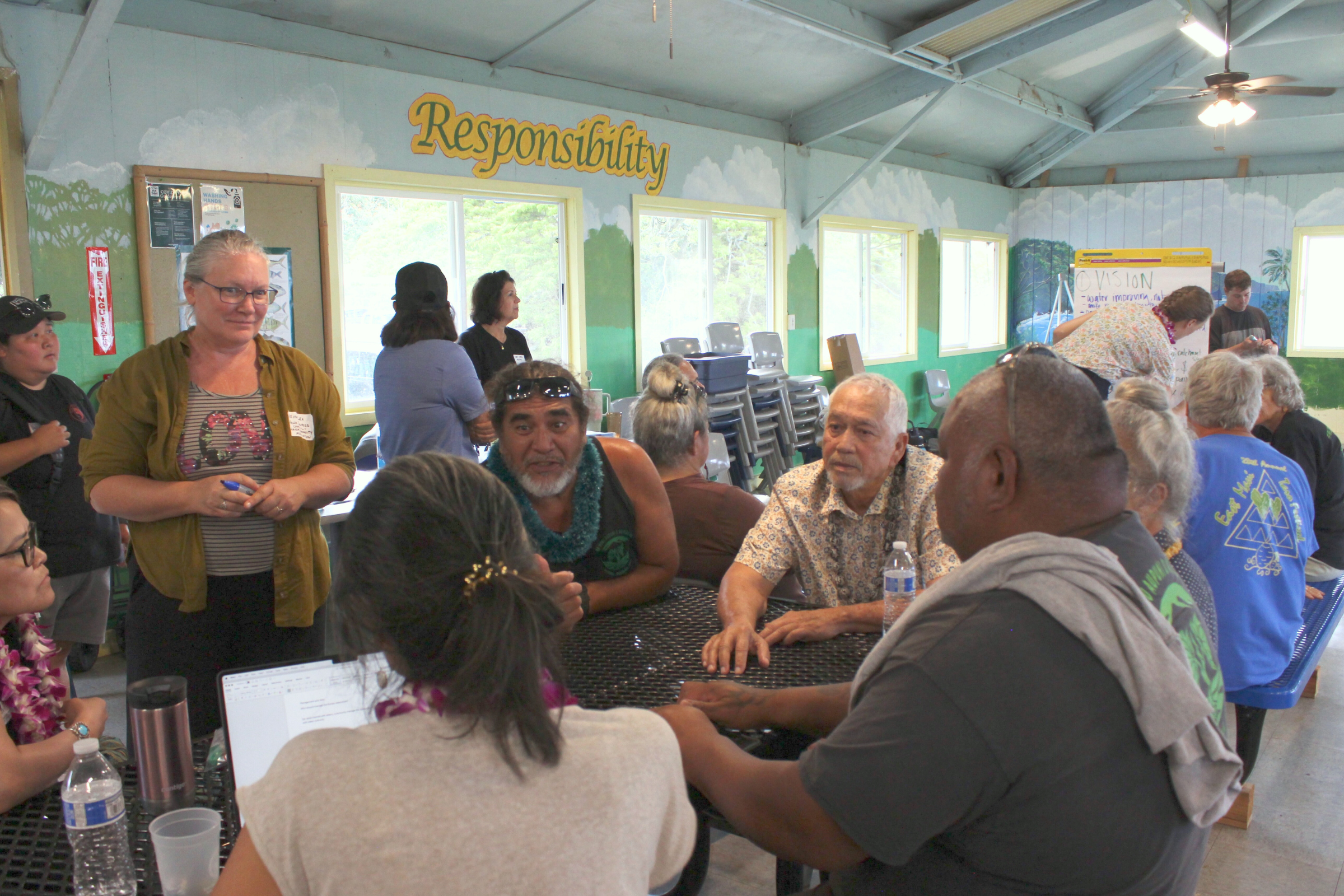

Left: Ed Wendt from East Maui speaks to community members during a county-led field trip to the area on June 16. Right: A view of the Makapipi Stream area from Hāna Highway. Residents are advocating for more public say in the region’s water distribution moving forward. | Megan Moseley, Overstory
Push for Community Management
Built between 1876 and 1923, the East Maui Irrigation System (EMI) comprises 74 miles of tunnels, ditches, inverted siphons and flumes, as well as eight reservoirs, and can carry more than 450 million gallons of water each day from the Ko‘olau Forest Reserve.
For over 100 years, the water system was controlled by Alexander & Baldwin, one of Hawai‘i’s former Big Five companies. EMI originally fed water to sugar plantations and has been used for agricultural and residential purposes in Central and Upcountry Maui.
‘Aha Wai O Maui Hikina and the EMWA were created to give community members a seat at the decision-making table for the Nāhiku, Ke‘anae, Honomanū and Huelo areas. Together, the entities are tasked with creating and implementing watershed management plans, acquiring and managing water systems and leases, and managing the distribution of water under the authority’s control.
East Maui residents said that community management is more prudent than ever, especially as Mahi Pono, which in June acquired full ownership of EMI, continues to seek a 30-year license to support its farming efforts in Central Maui. Mahi Pono is an agricultural company jointly owned by California-based Pomona Farming and one of Canada’s largest pension funds, PSP Investments.
Grant Nakama, senior vice president of business operations at Mahi Pono, wrote in an email that Mahi Pono has farmed more than 20,000 acres of former sugarcane lands for the past seven years and is committed to responsible water use.
“During this time, we have made every reasonable effort to focus on water-efficiency on-farm, and our commitment to responsible water use has allowed Mahi Pono to meet, and in many cases exceed, the stringent water efficiency standards mandated by the Hawai‘i Board of Land and Natural Resources,” he wrote. “In addition to Mahi Pono’s water efficiency obligations, the general availability of water must be acknowledged as an essential component of local farming and in-state food production. Mahi Pono is committed to working collaboratively with all parties to ensure access to water for sustainable farming in Central Maui.”
Māhealani Perez-Wendt, a poet, writer and activist from Ke‘anae, and her husband, Ed Wendt, are among many who have been involved in water rights in the courts for years. She said the time is now for a new chapter to be written.
“It will either be that the leases are approved or, as we see it in the community, the East Maui Water Authority can take over management,” she said.
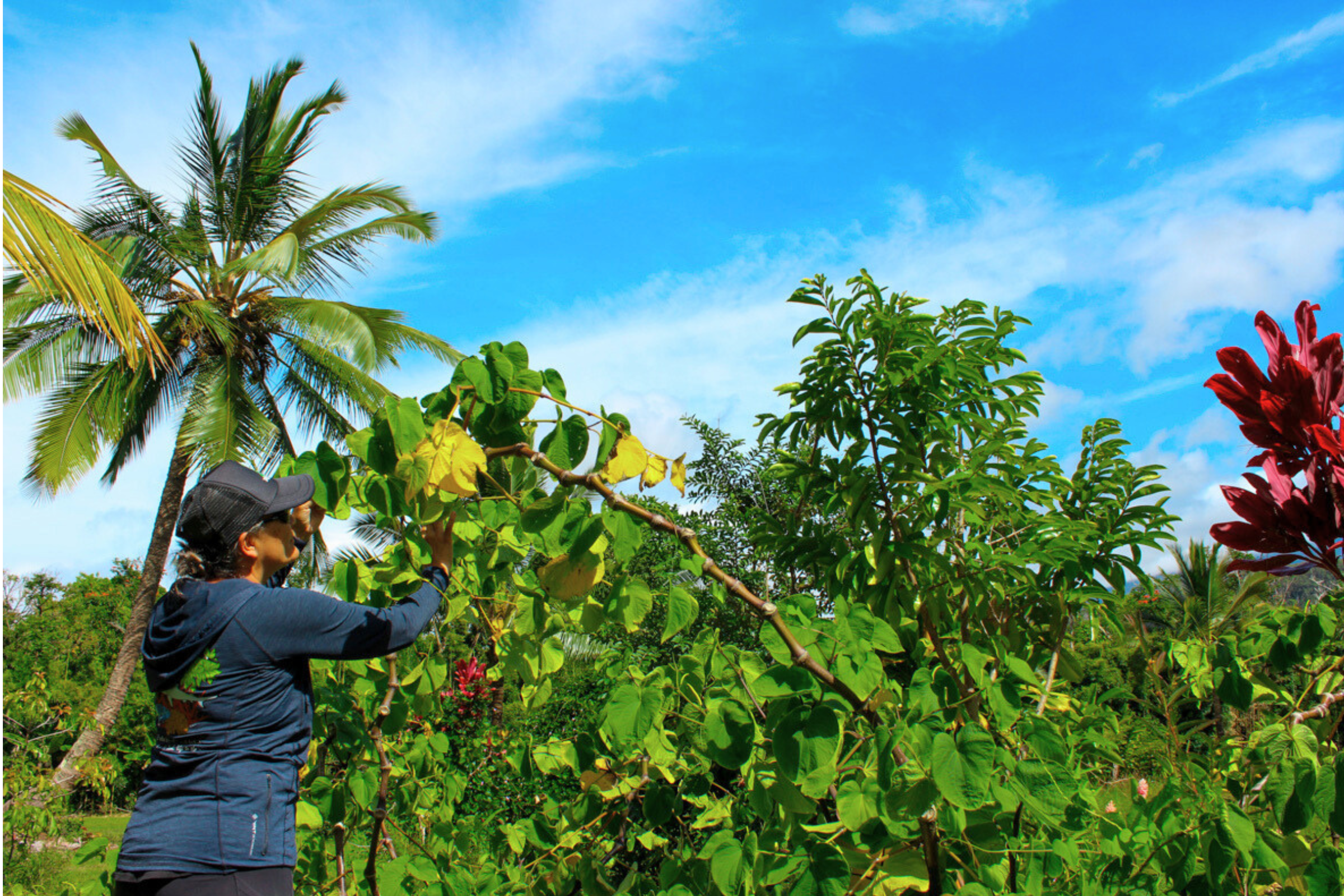
The state Commission on Water Resource Management was established in 1987 and, with it, a code that stated that the state’s waters are for the benefit of its citizens. Above, Renee Roback Miller takes care of a tree during a recent public field trip to East Maui to discuss watershed planning. | Megan Moseley, Overstory
Reflections on Decades-Long Advocacy and Diverted Water
EMWA, along with ‘Aha Wai O Maui Hikina, hosted public events in Ke‘anae, Ha‘ikū and Kula in June to discuss watershed and water resource planning and hear feedback and concerns from water stakeholders—a step toward creating a community-led watershed plan for East Maui. Residents at the June 16 meeting emphasized how water diversions have impacted their lives.
In the ahupua‘a of Ke‘anae and Wailuanui, Nā Moku ʻAupuni ʻo Koʻolau Hui cares for nearly 400 acres of lo‘i and has been involved in several legal challenges to protect the region’s water for the last 20 years. Standing next to a 30-year-old taro patch, Jerome Kekiwi Jr., president of the organization, said the lack of water impacted residents’ abilities to farm, fish and live in the area.
“When 100% of the water was taken, everything was gone,” he said in a despondent tone.
Traditional cultural practices recycled the water for kalo farming and ensured its preservation to support the area’s delicate ecosystem.
Lurlyn Scott, an East Maui kalo farmer and member of ‘Aha Wai O Maui Hikina, said commercial water diversions have also meant that keiki cannot swim in the places that elders enjoyed when they were children.
“Our children have not seen what taro patches and a whole system looks like because it’s been devastated by this lack of concern for the original people here on the land,” she said.
East Maui kalo farmers, Native Hawaiian activists and environmental groups have been fighting to reduce diversion amounts and restore streams since the 1980s. Ke‘anae resident Jessie Kekiwi-Aweau said she gives credit to those who came before her to help amplify their families’ voices.
“I give my kūpuna credit for stepping up to A&B,” she said. “If it wasn’t for them, we wouldn’t be fighting and probably would have lost the water.”
Sixth-generation taro farmer Ed Wendt said they’ve experienced some victories over the years, with multiple streams being ordered to return to 100%. He said he hopes to see these streams remain at that level and for the rest of the streams that were identified by his kūpuna to one day be fully restored.
He also said the fight was not personal, but a kuleana of their community.
“We realize water is so precious; we realize and we always have realized everybody needs water,” he said. “We wasn’t here to fight everybody. Our fight was against Alexander & Baldwin and nobody else. Not the people of the upcountry, not the farmers, anybody, we was not against you. We were fighting for survival for our way of life.”

A lo‘i kalo in East Maui. Before stream water was diverted to other parts of the island, kalo farming recycled the region’s water and ensured its preservation to support the area’s delicate ecosystem. | Megan Moseley, Overstory
A New Future
Moses Bergau Jr., an ‘Aha Wai O Maui Hikina board member from Nāhiku, pointed toward remnants of ancient lo‘i in Nāhiku while a crowd of onlookers listened attentively.
“This was the main subsistence of the food supply,” he said. “This small little area, and what you see down below here is remnants of lo‘i patches and they still exist today, so the possibility of having it returned is great.”
He hopes a new future may form through kapu aloha, or acting with kindness, love and empathy.
“Confrontation does not work,” he told the crowd. “Misinformation spreading out does not work. That’s one of our goals—to bring back the mana‘o, the mana.”
Gina Young, the new director of the EMWA, said the authority’s plan is to bring local, generational knowledge and cultural practices back into the water resource management process.
During the public events, community members shared they want to see future watershed restoration efforts provide jobs and educational opportunities. Young said the EMWA plans to create an East Maui base yard and workforce. The County Council also added watershed workers to the budget to help build the EMWA’s new watershed division.
“While we are still in the early phases of getting established, we are excited for a new future,” she said.
Community members also said they want to see collected data be managed by East Maui residents, as well as increased kalo cultivation, support for area farmers, help addressing invasive species, and preservation of the surrounding ‘ōhi‘a forests.
Jonathan Likeke Scheuer, chair of ‘Aha Wai O Maui Hikina and a water resource expert, said the EMWA hopes to eventually acquire a long-term lease for EMI. According to the Honolulu Star-Advertiser, a long-term lease is expected be auctioned by the state Department of Land and Natural Resources after holding a quasi-judicial contested-case hearing.
The goal is for EMWA to be “a utility for non-potable water,” he said, adding that while the creation of a government-established community water authority might be new to Maui, it’s not unheard of in other areas of the world, where water is viewed as a public resource.
“The single largest water system on the island of Maui should be controlled by the people of Maui,” he said.